
Grand Design for Human Resources
Execute a Grand Design for Human Resources
"Making JUKI a sustainable company"
JUKI's Grand Design for Human Resources was created by employees who held such a aspiration. Each measure of Grand Design for Human Resources are about 30 measures across 4 areas. Encompassing all challenges surrounding every employee. Regular reports are made on the status of each measure, allowing employees to feel that 'employee happiness' is increasing day by day.
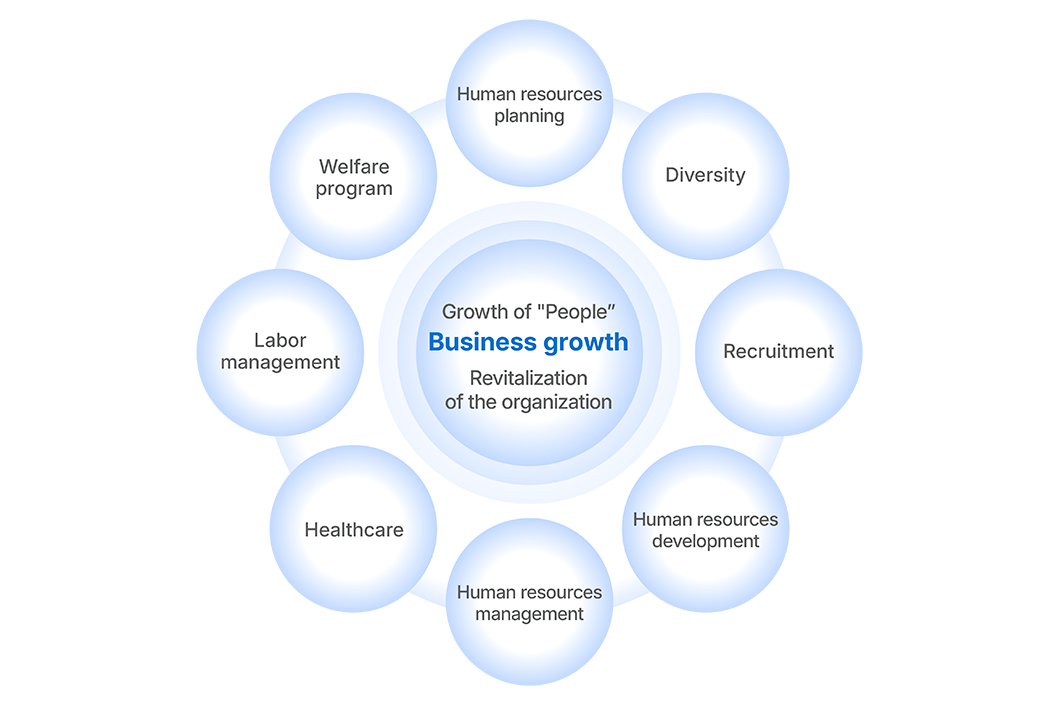
Promoting the Growth of Every Employee Happiness
The JUKI's "Grand Design for Human Resources" are divided into four measures: "Independence and self-reliance that lead to growth" "DE&I initiatives" "Responding to performance at work" and "Improving employee engagement".
1Independence and self-reliance that lead to growth
We invest opportunities that allow each employee to have a sense of independence and self-discipline, leading to growth. We will also will rotate human resources more widely and frequently throughout Japan and overseas, improve individual abilities, and share diversity and values by tailoring our human resource system to careers and expertise and more often sending younger employees on overseas business trips. In our overseas offices, we are actively promoting national staff to management positions.
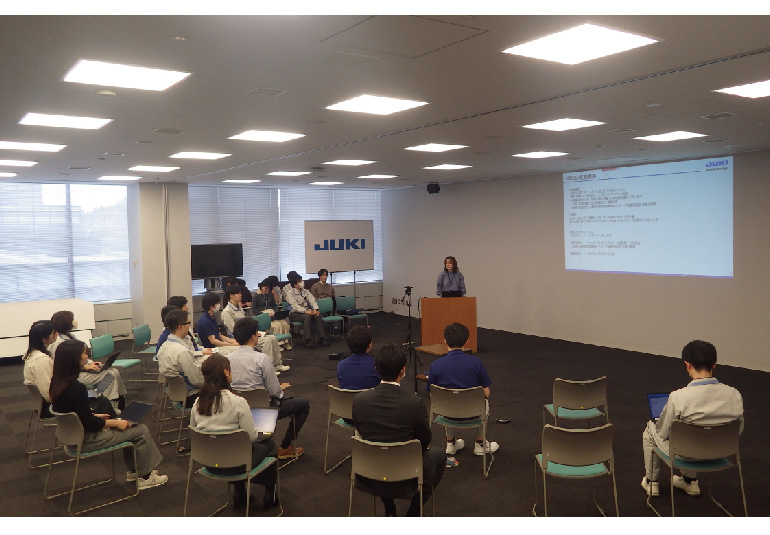
Initiatives for career development for young employees
As part of our efforts to support the career development of young and mid-level employees, we are creating an environment where every individual can broaden their perspective on work and think proactively and independently about their future careers and visions. In our “career talk rooms,” senior employees share the knowledge and experiences they have gained through their careers and answer questions from participants. Our “career interviews” are another useful career development mechanism specifically designed for JUKI employees under the age of 40. By visualizing and supporting individual career paths, we aim to realize employee happiness and interweave it with JUKI’s succession plans.
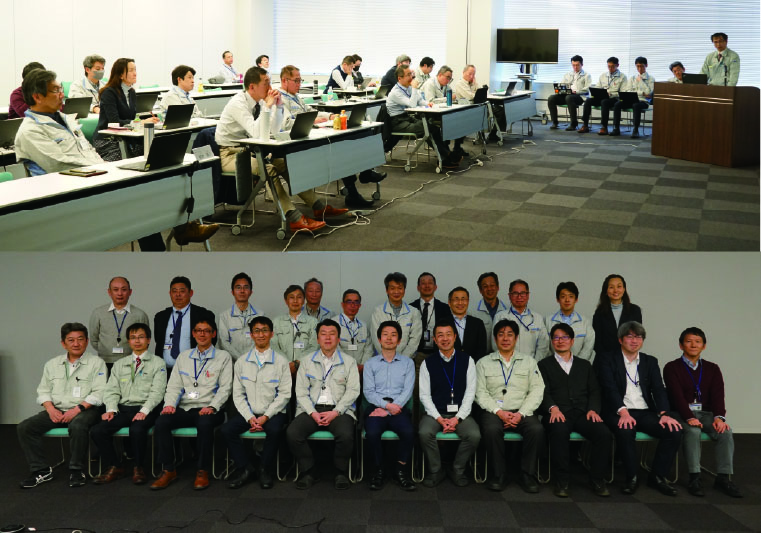
Training programs for the development of future leaders
We launched a management candidate training program aimed at discovering and expanding a reserve of next-generation management candidates and improving their skills. Program participants attended lectures on management issues, management fundamentals, and management presented by executives and took part in discussions with top management and executives to gain an understanding of management issues and a sense of their own potential participatory roles as future managers. This program is expected to create diverse human resources with opportunities to engage in management.

“JUKI Award” program
This award globally recognizes employees and teams that have made outstanding achievements in business activities related to the functions such as development, manufacture, and sale of new products, the promotion of new businesses, VE activities, and safety.
This award ceremony helps motivate employees.
2DE&I initiatives
As an enterprise that operates globally, JUKI employs people from diverse social backgrounds who hold diverse values. Every employees can choose work systems that accommodates flexible working styles for their diversity and playing an active role. JUKI actively promote DE&I(DIversity,Equity,Inclusion).
Work systems
| Staggered working hours system |
This system allows employees to choose work hours that suit their individual lifestyles with the aim of improving time awareness, work motivation, and work efficiency. Employees may come to work up to two hours earlier or later than their regularly scheduled working hours, with prior approval. |
|---|---|
| Shortened working hours system |
This system allows employees to shorten their daily working hours to secure the time needed to fulfill duties such as motherhood, the raising of children, or care-providing for immediate family members. Working hours may be shortened in one-month increments up to a maximum of two hours per day. |
| Optional shortened working hours system |
This system allows employees to shorten the number of days they are scheduled to work per week, in order to enhance their work and life balance, etc. Employees can choose to work either a four-day workweek or a three-day workweek in six-month increments, and can use this system in conjunction with the shortened working hour systems offered. |
| Teleworking system |
This system allows employees to work from home in order to achieve more productive work styles by balancing their working burdens with other burdens associated with commuting, family circumstances, or the like. Employees may work outside of their homes in public or private rental offices approved by the company. Employees are paid an allowance for the days they work from home. |
| External side job system |
This system allows employees to work for other companies while continuing to work for our company. Employees can also engage in work as sole proprietors or entrepreneurs, work as employees of other companies, or as business supporters or the like in social contribution projects to meet the SDGs. |
| Internal side job system (in-house support) |
This system allows employees to easily support the work of other departments for short periods without having to officially change departments. The system activates supports for cross-departmental work and creates opportunities for increased communication, idea generation and spontaneous job development. |
Pillars of action for promoting diversity
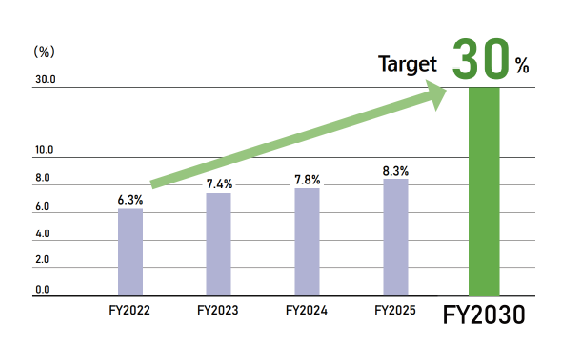
Female management positions
30% by fiscal 2030
We promote women's participation in the workforce as a key policy. Our goal is to fill at least 30% of all management positions at JUKI by women by fiscal 2030.
Male employees childcare leave utilization
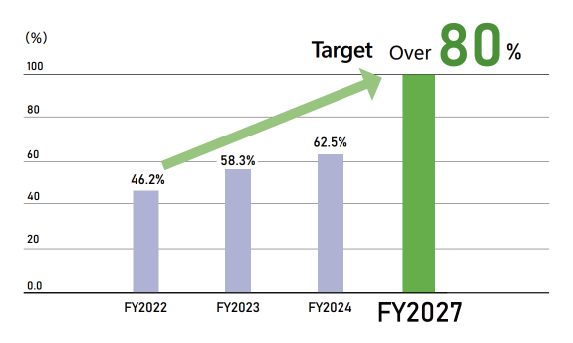
80% by fiscal 2027
We aim to increase the rate of male employees taking childcare leave to over 80% by 2027, in order to support the balance between work and childcare and create a comfortable work environment for all employees.

Assigning global human resources
JUKI is promoting personnel exchanges among its group companies so that employees can further advance their careers globally.
Changes emerging from different values and cultures encourage employee and organizational growth.
3Responding to performance at work
This system adjusts the treatment of employees dynamically based on their willingness to take on challenges and achieve results without fear of failure. Regarding salaries, we have introduced a job-based human resource management system (job duties and job performance) for both managers and rank-and-file employees and link their bonuses to their business performance. For our managers, we are now reflecting performance results to a far greater extent. For young and mid-career employees, we will take steps to quickly develop them into competitive forces and promote them to managerial positions as soon as possible.
- Salary system
-
- New performance-based bonus system
- Job-based human resource management system
4Improving employee engagement
To Improving employee engagement and work-life balance,we promote comfortable and rewarding work environments. And we promote health management by positioning employee health as an important corporate asset and by aiming to maintain and improve our employees’ physical and mental health and vitality.
- Improving employee engagement
-
- Comfortable and rewarding work environments
- Health management initiatives
Comfortable and rewarding work environments

Promoting work-life balance
We have established systems that enhancing work-life balance.such as utilizing satellite offices, introducing free address workspaces in the office, and encouraging telecommuting every Friday, enhancing work-life balance.

Encouragement to take paid leave
We have set a goal the ratio of employees taking 12 or more days of paid leave will be 80% by fiscal 2027. and we are creating an environment where employees can easily take paid leave, such as by establishing recommended days.

Less than 30 hours
Work on non-statutory and statutory holidays
We have set a goal to reduce the average number of hours worked by regular employees on non-statutory and statutory holidays less than 30 hours per month by fiscal year 2027, and we are actively promoting proper labor time management.
Health management initiatives
We promote health management by positioning employee health as an important corporate asset and by aiming to maintain and improve our employees’ physical and mental health and vitality. In 2024, we collaborated with the JUKI Health Insurance Association to reduce the risk of stomach cancer, promote preventive dentistry, and prevent the aggravation of lifestyle-related diseases. In recognition of these initiatives, JUKI has been certified as a “Health and Productivity Management Organization (KENKO Investment for Health)” in each of the nine years since it established its Health Management Declaration in 2017. Our measures to promote health management seek to enhance corporate productivity and creativity while achieving sustainable growth. A parallel aim in our efforts to modify JUKI’s work environments is to enable every employee to find satisfaction in their work.