
Quality Assurance
Basic Attitude Towards Quality Assurance
Since its founding, JUKI has provided high-quality products and services that support our customers’ manufacturing operations, backed by our commitment to durable and reliable “JUKI Quality.” We believe that quality is more than a product attribute. It is a vital management foundation that supports customer safety and peace of mind, business continuity, and trust in the JUKI brand. As market demands continue to evolve, we regard quality as a key source of competitiveness and strive for continuous quality improvement across all business processes, including development, procurement, production, sales, and service.
Quality Management System
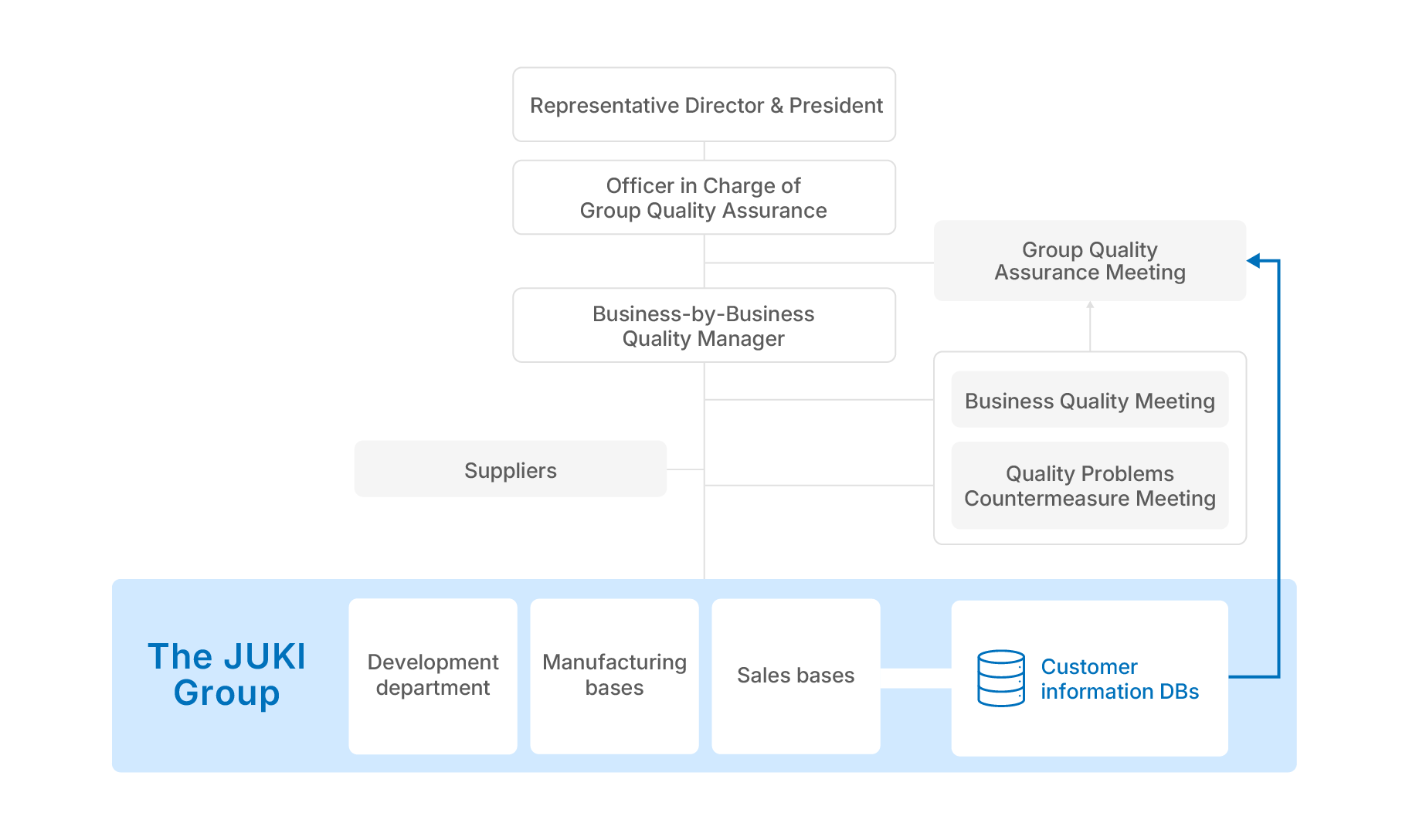
JUKI maintains and improves quality by holding regular quality-focused meetings of the development, manufacturing, and sales departments of each business, and by including suppliers in their quality-focused dialogs. In the unlikely event of a quality problem, the JUKI Group deploys a Group-wide system designed to solve defects as quickly as possible.
The JUKI Group Quality System Chart
Quality Assurance Initiatives
The “Four-process Consistency Activity,” a project we have been working on since 2019, has achieved tangible results, but progress has been slowed by quality issues on the manufacturing lines. In this connection, we launched the following measures in FY2024 as another of our "Quality Re-Inspection Activities" to further improve manufacturing quality.
Quality Re-Inspection Activities
| Business partner audits | We conduct audits of our business partners and determine the frequency of inspections and guidance from JUKI based on their technical and management capabilities. We eliminate the delivery of defective (non-conforming) products and stabilize quality by deploying a product-acceptance system tailored to the technical capabilities of our business partners. (JUKI audited 298 companies in 2024.) |
|---|---|
| Cross-audits between manufacturing sites |
The four-process consistency activity revealed that the self-audit tended to be subjective and to accommodate site-specific circumstances in ways that inadvertently hampered improvement levels. Therefore, we improved our auditing methods to enable third-party process audits (two-process consistency confirmation) by conducting cross-audits in which individual manufacturing sites audited each other. By sharing strengths and visualizing weaknesses between bases and implementing improvement measures, we will improve process quality to ensure that defective products are never produced or overlooked. |
| Manufacturing proposal document |
Since products with new features tend to have more problems, we added a step to submit a manufacturing proposal as a manufacturing-based risk assessment covering things like past manufacturing issues, ease of manufacturing, standardization and reduction of parts, and work safety during the product development process. These manufacturing proposals stabilize mass production, improve product quality at launch, and make new features easier to understand. |
Maintenance and Management of Quality Management Systems
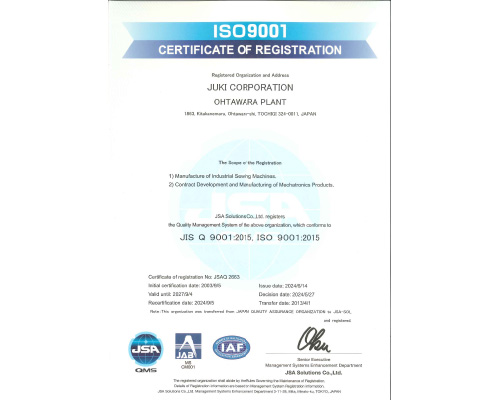
JUKI has obtained ISO 9001 certification at each of its production sites and continuously maintains and improve its quality management system. The OHTAWARA PLANT, JUKI’s main domestic factory, formulates annual plans for quality activities and responds to ISO audits and QC activities. JUKI’s Quality HKK Committee launched at the OHTAWARA PLANT in FY2024 identifies quality risks in manufacturing sites, compiles countermeasures and evaluations, and deploys a system for thoroughly improving risks. Quality management is implemented at other JUKI’s production sites through internal audits and external evaluations performed in accordance with ISO standards.