
Grand Design for Human Resources
Basic Approach
To develop human resources who can navigate the business environment more flexibly and robustly, we are promoting the growth of every employee and revitalizing our organization through a positive cycle of three activities: “providing opportunities for growth,” “embracing diverse values,” and “responding to expanded job responsibilities and performance at work.” We believe that a ”comfortable and rewarding work environment” is the foundation of this cycle and is essential for enhancing employee engagement. To support this, we implement measures that contribute to employee health and motivation.
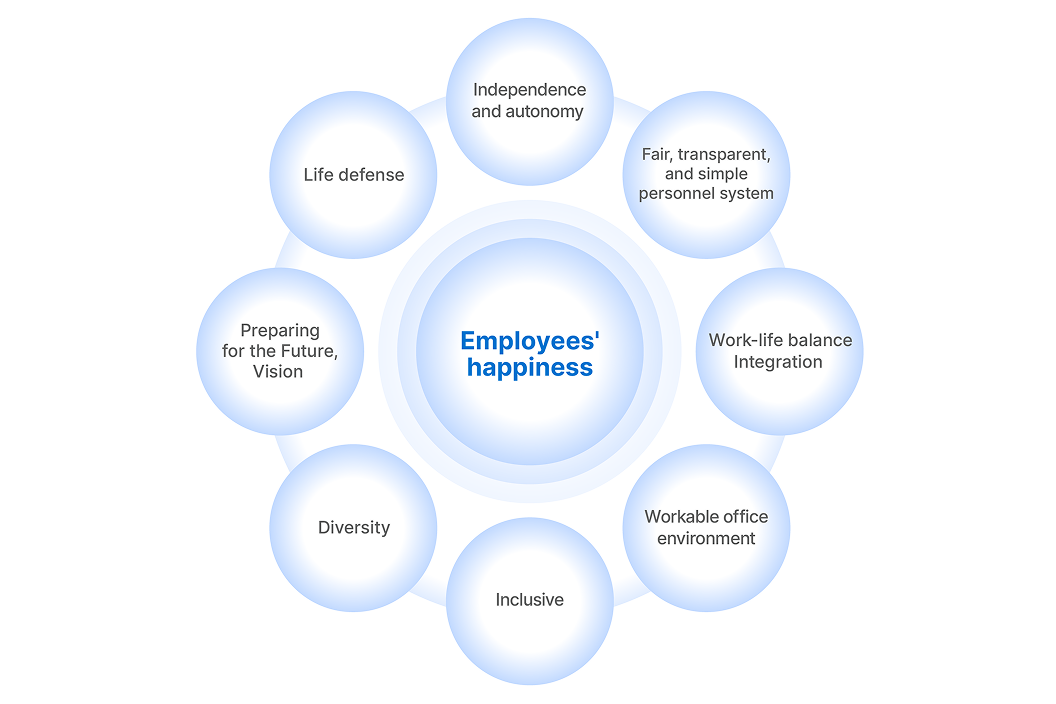
Grand Design for Human Resources
JUKI formulated its Grand Design for Human Resources, centered on “Employee Happiness,” by utilizing the opinions gathered from members of the Human Resources Grand Design Project, which consisted of employees representing a wide range of age groups and organizations. The measures outlined in the Grand Design are divided into four areas: “Growth,” “DEI,” “Responding to Performance at Work,” and “Engagement.”
1Growth
We believe that the sustainable growth of our organization depends on employees learning, growing, and acting with independence and self-reliance. To support this, we invest in human resource development. Through career-based HR systems, overseas training for younger employees, and global job rotations, we promote talent development and the sharing of diverse values across the Group.
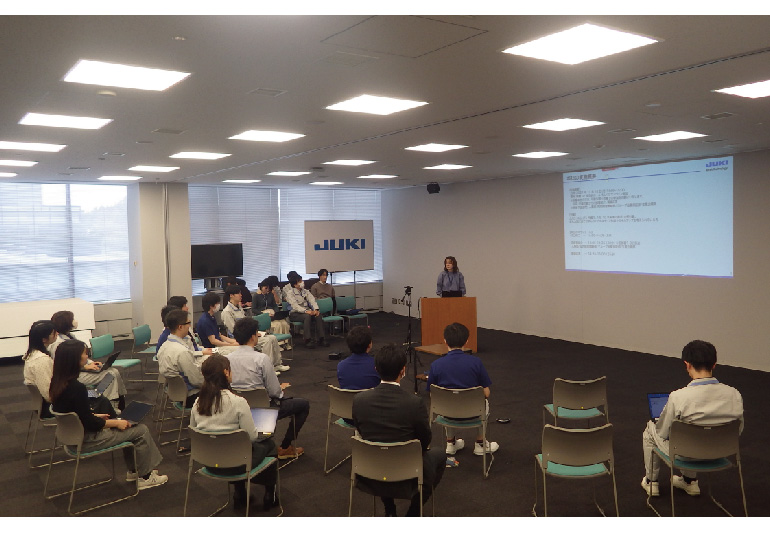
Young Employee Presentation Meeting
JUKI holds a Young Employee Presentation Meeting for fourth-year employees to help them recognize their growth and consider their future careers. By reflecting on their experiences and learning, and receiving feedback from supervisors and colleagues, participants broaden their perspectives and gain motivation for further growth.
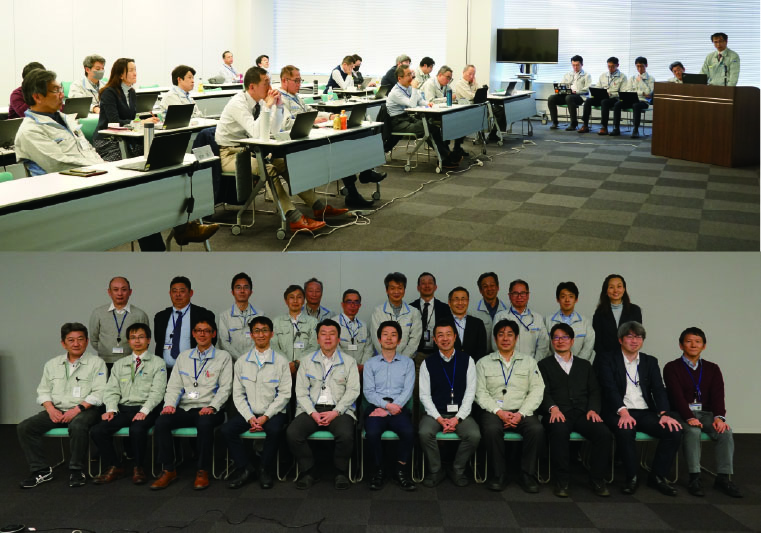
Future Leaders Program
In this program, executive officers select next-generation leadership candidates based on aptitude rather than age. Through workshops and dialogue with senior management, participants develop practical management perspectives while working on initiatives to improve business performance. We will continue this initiative to develop future leaders and support our succession plan.
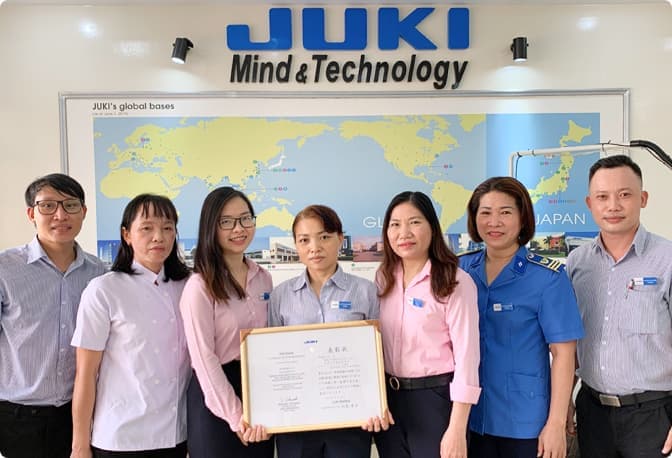
“JUKI Award” Program
This award globally recognizes employees and teams that have made outstanding achievements in business activities related to the functions such as development, manufacture, and sale of new products, the promotion of new businesses, VE activities, and safety.
This award ceremony helps motivate employees.
2DEI
As an enterprise that operates globally, JUKI employs people from diverse social backgrounds who hold diverse values. Every employees can choose work systems that accommodates flexible working styles for their diversity and playing an active role. JUKI actively promote DE&I(DIversity,Equity,Inclusion).
Work Systems
| Staggered working hours system |
This system allows employees to choose work hours that suit their individual lifestyles with the aim of improving time awareness, work motivation, and work efficiency. Employees may come to work up to two hours earlier or later than their regularly scheduled working hours, with prior approval. |
|---|---|
| Shortened working hours system |
This system allows employees to shorten their daily working hours to secure the time needed to fulfill duties such as motherhood, the raising of children, or care-providing for immediate family members. Working hours may be shortened in one-month increments up to a maximum of two hours per day. |
| Optional shortened working hours system |
This system allows employees to shorten the number of days they are scheduled to work per week, in order to enhance their work and life balance, etc. Employees can choose to work either a four-day workweek or a three-day workweek in six-month increments, and can use this system in conjunction with the shortened working hour systems offered. |
| Teleworking system |
This system allows employees to work from home in order to achieve more productive work styles by balancing their working burdens with other burdens associated with commuting, family circumstances, or the like. Employees may work outside of their homes in public or private rental offices approved by the company. Employees are paid an allowance for the days they work from home. |
| External side job system |
This system allows employees to work for other companies while continuing to work for our company. Employees can also engage in work as sole proprietors or entrepreneurs, work as employees of other companies, or as business supporters or the like in social contribution projects to meet the SDGs. |
| Internal side job system (in-house support) |
This system allows employees to easily support the work of other departments for short periods without having to officially change departments. The system activates supports for cross-departmental work and creates opportunities for increased communication, idea generation and spontaneous job development. |
Pillars of Action for Promoting Diversity
Women's Empowerment and Women in Management Positions
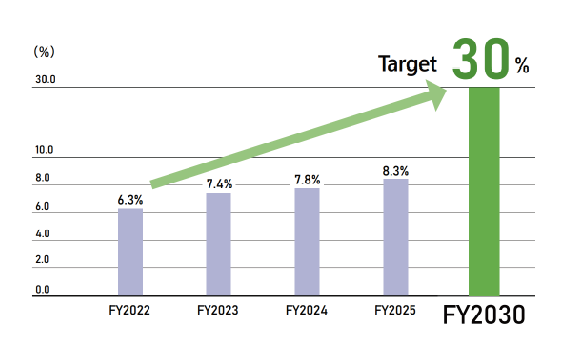
We regard the promotion of women's empowerment and the advancement of women into management positions as key priorities. Through training and institutional reforms, we are creating an environment that supports women's success and have set a target of increasing the ratio of female managers from 10% in fiscal 2025 to 30% by fiscal 2030. In recognition of these efforts, JUKI has been awarded the highest level (three-star) Eruboshi Certification for its excellence in supporting women's active participation and career advancement.
Childcare and Life Event Support
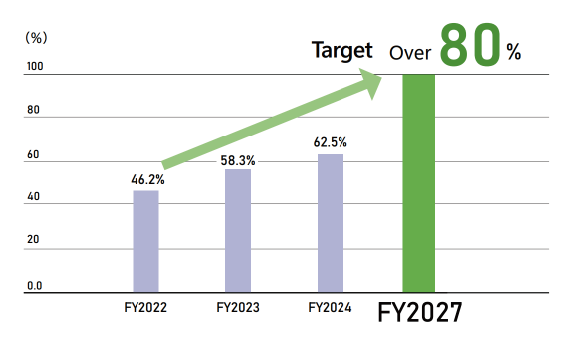
We are enhancing support for employees' childcare responsibilities, return-to-work programs, and other life events. In fiscal 2025, we achieved a 100% childcare leave utilization rate among male employees. We have also introduced new initiatives, including compliance with revised childcare and nursing care legislation and a leave program that supports employees in balancing work and childcare. Through these efforts, we aim to obtain Kurumin Certification, which recognizes companies that provide outstanding support for balancing work and childcare.
3Responding to Performance at Work
We provide dynamic rewards for employees who take on challenges and deliver results. For both managerial and non-managerial employees, compensation is based on job responsibilities and performance, while bonuses are linked to results through a performance-oriented system. For managers, greater emphasis is placed on business results, while younger employees are encouraged to develop quickly and advance to management positions at an early stage.
Review of Compensation Levels
We continuously review compensation levels, including salaries and bonuses, to provide an environment in which employees can work with confidence and peace of mind. In fiscal 2026, we implemented salary revisions, including base pay increases, in response to inflationary trends and changes in the business environment. We also significantly enhanced bonus standards as part of our ongoing efforts to improve employee compensation.
Employee Compensation
To ensure that employees can work with confidence, we regularly review compensation levels, including salaries and bonuses. In fiscal 2026, we implemented base pay increases and enhanced bonus standards in response to changes in the external environment. In determining compensation, we consider business performance, market competitiveness, and employees' well-being, while continuing to share the benefits of growth with employees in accordance with our profit distribution policy.
4Improving Employee Engagement
To Improving employee engagement and work-life balance,we promote comfortable and rewarding work environments. And we promote health management by positioning employee health as an important corporate asset and by aiming to maintain and improve our employees’ physical and mental health and vitality.
- Engagement
-
- Rewarding Work Environment
- Health Management Initiatives
Rewarding Work Environment

Rewarding Workplace
As part of our employee engagement initiatives, we established a Communication Lounge based on employee feedback gathered through a survey on multipurpose space utilization. Designed for individual work, meetings, team discussions, and relaxation, the space promotes workplace communication and employee interaction.
Promoting Paid Leave Utilization
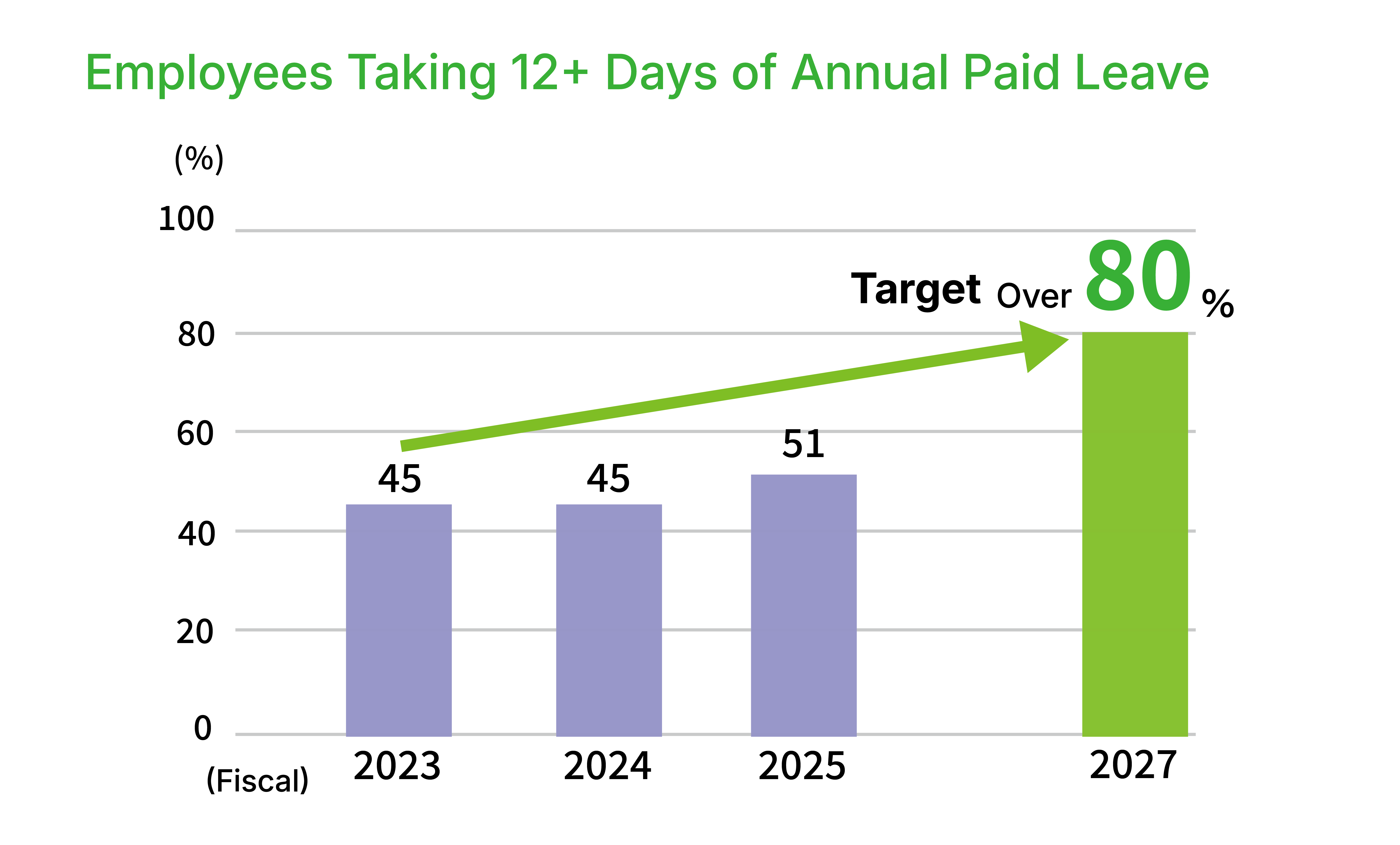
We support diverse and flexible work styles through various initiatives, including encouraging remote work every Friday and promoting the use of flexible working arrangements. We have also set a target of increasing the percentage of employees taking at least 12 days of annual paid leave to over 80% by fiscal 2027. To achieve this goal, we are creating an environment that encourages planned leave-taking, including the designation of recommended paid leave days.
Health Management Initiatives
We consider employee health and workplace well-being to be key priorities and promote a range of initiatives to support them. We maintain a 100% participation rate in annual health checkups and target a 100% implementation rate for specified health checkups and health guidance programs. We also keep average holiday overtime below 10 hours per month, helping employees achieve healthy and sustainable working styles. As a result of these efforts, JUKI has been recognized as a Health and Productivity Management Outstanding Organization for 10 consecutive years from 2017 to 2026 and has earned high recognition from both internal and external stakeholders.